The Kena Upanishad is one of the most subtle and penetrating texts of Indian philosophy. Instead of describing God, rituals, or cosmology, it asks a radical question:
By whom is the mind directed?
By whose power do the senses function?
For modern seekers searching for the Kena Upanishad in English, this text offers a direct inquiry into consciousness, perception, and the source of all experience. Its teachings are timeless, yet strikingly relevant in an age dominated by sensory overload and intellectual certainty.
What Is the Kena Upanishad?
The Kena Upanishad belongs to the Sama Veda and is one of the principal Upanishads. Its name comes from the opening word “Kena”, meaning “by whom”—a question that sets the tone for the entire text.
Rather than giving answers in the usual sense, the Kena Upanishad points the reader beyond thought, beyond perception, and beyond the known.
The Central Teaching of the Kena Upanishad
The Upanishad reveals a profound truth:
That which enables the mind to think cannot itself be an object of thought.
That which enables the eye to see cannot itself be seen.
This teaching shifts the seeker’s attention from objects of experience to the source of experience itself.
In Advaita Vedanta, this source is recognized as Brahman—not an entity, but pure awareness.
Why Read the Kena Upanishad in English?
Most modern readers look for:
- Kena Upanishad in English
- Kena Upanishad explained in simple language
- Kena Upanishad meaning and commentary
- Advaita Vedanta books in English
An English interpretation allows seekers to engage deeply with the text without needing Sanskrit scholarship, while still preserving its philosophical depth.
Challenges With Traditional English Translations
Many older translations:
- Use highly academic or archaic language
- Focus on literal meaning rather than insight
- Do not bridge the gap between text and lived experience
As a result, readers may understand the words—but miss the revelation the Upanishad is pointing toward.
The Kena Upanishad and Advaita Vedanta
The Kena Upanishad is firmly rooted in non-dual (Advaita) wisdom. It makes it clear that:
- Brahman is not an object
- Knowledge of Brahman is not intellectual
- True understanding is recognition, not acquisition
Ignorance is not lack of information, but misplaced identification with the mind and senses.
Power Beyond Perception: A Modern Reading of the Kena Upanishad
To truly understand the Kena Upanishad, one must move beyond interpretation and arrive at direct insight. This is where modern, clarity-focused explanations become essential.
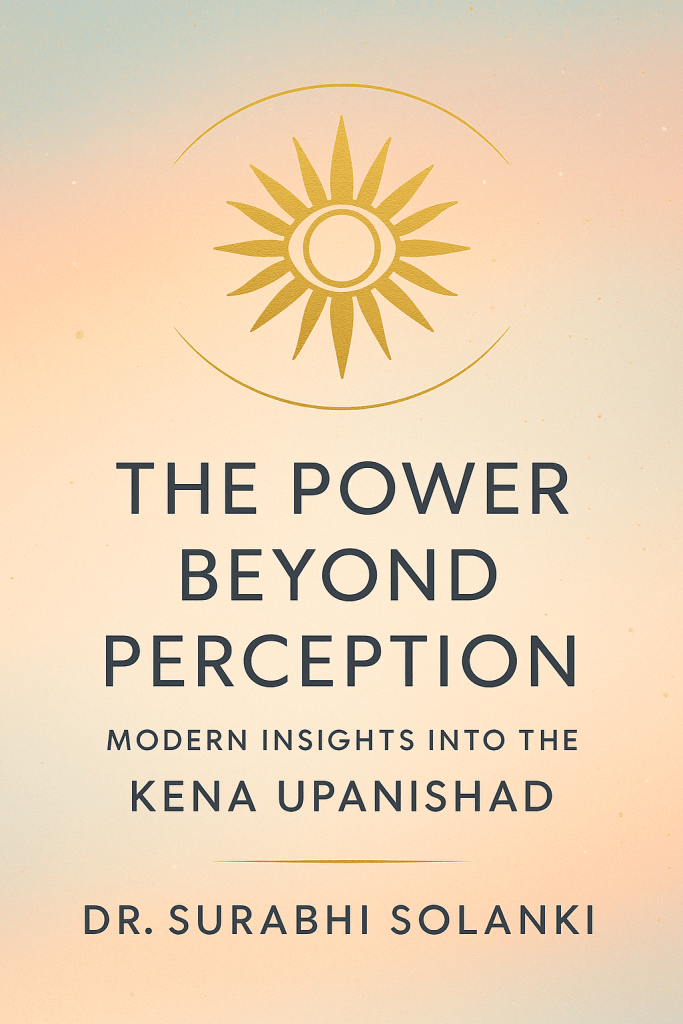
Power Beyond Perception: Modern Insights into the Kena Upanishad approaches the text not as philosophy to be memorized, but as a mirror for self-inquiry.
What This Book Brings to the Reader
- Clear, modern English without dilution of depth
- Focus on awareness behind perception, not metaphysics
- Connection between ancient insight and modern consciousness
- Guidance toward seeing rather than believing
Instead of explaining about Brahman, the book consistently points the reader toward what is already present as awareness.
The Devas and the Yaksha: Symbolism Explained
One of the most striking sections of the Kena Upanishad is the story of the Devas and the mysterious Yaksha.
Symbolically:
- The Devas represent the powers of the senses and intellect
- The Yaksha represents Brahman, the unknown source
The story reveals that ego and intellect cannot grasp the ultimate truth, even though they depend on it completely.
This teaching is especially relevant in a world that overvalues knowledge but overlooks awareness.
Who Should Read the Kena Upanishad?
The Kena Upanishad is ideal for:
- Seekers interested in consciousness studies
- Readers of Advaita Vedanta
- Those dissatisfied with purely devotional or ritualistic texts
- Individuals exploring the limits of perception and knowledge
- Readers of the Upanishads, Mandukya Karika, and non-dual philosophy
Why the Kena Upanishad Is More Relevant Today Than Ever
In a time of:
- Information overload
- Sensory distraction
- Intellectual certainty
The Kena Upanishad quietly asks:
What is it that knows all this?
This single question has the power to dissolve confusion at its root.
Final Thoughts
Reading the Kena Upanishad in English is not about accumulating spiritual knowledge. It is about turning attention back to its source.
Books that approach this Upanishad with clarity and experiential depth—rather than commentary alone—serve as powerful companions on the path of self-knowledge.
The Kena Upanishad does not give answers.
It removes the false questioner.
And in that silence, truth stands revealed.

 Dr Surabhi Solanki