If you are searching “what is Advaita Vedanta philosophy”, you are seeking the essence of one of the most profound systems of thought ever articulated—a philosophy that does not ask you to believe, but to understand reality as it is.
Advaita Vedanta is not a religion, a ritual system, or a belief structure.
It is a direct inquiry into truth, self, and freedom.
This article explains Advaita Vedanta clearly, authentically, and simply, while also guiding you to modern books that make this wisdom accessible for today’s reader.
The Meaning of Advaita Vedanta
The term Advaita Vedanta is composed of two words:
- Advaita — non-dual (not two)
- Vedanta — the end or culmination of the Vedas
Advaita Vedanta means:
The philosophy that reveals the non-dual nature of reality.
According to Advaita Vedanta, there is only one reality, and the sense of separation we experience is due to misunderstanding.
The Core Teaching of Advaita Vedanta
The central assertion of Advaita Vedanta is simple yet radical:
Brahman (ultimate reality) alone is real.
The world is an appearance.
The individual self is not separate from Brahman.
In short:
You are not separate from the reality you seek.
What Is Brahman in Advaita Vedanta?
In Advaita Vedanta, Brahman is:
- Infinite
- Changeless
- Formless
- Beyond time and space
- Pure consciousness
Brahman is not a god with form, but the ground of all experience.
What Is the Self (Atman)?
Advaita Vedanta teaches:
Ātman (the Self) is identical to Brahman.
This means:
- Your true nature is not the body
- Not the mind
- Not the personality
- But the awareness in which all experiences appear
Liberation comes from recognizing this truth, not from becoming something new.
Why Advaita Vedanta Says the World Is Not Ultimately Real
Advaita Vedanta does not deny the world’s experience.
It explains that the world is relatively real, not absolutely real.
Just as:
- A dream feels real while dreaming
- But dissolves upon waking
Similarly, the world appears real due to ignorance (avidyā).
This does not promote escapism—it promotes clarity.
Bondage and Liberation in Advaita Vedanta
Bondage
Bondage arises from:
- Identification with body and mind
- Mistaking the changing for the permanent
- Ignorance of one’s true nature
Liberation (Moksha)
Liberation is:
- Not an event in time
- Not a future reward
- Not something attained after death
Liberation is knowledge removing ignorance—here and now.
Advaita Vedanta and Action (Karma)
Advaita Vedanta does not reject action or life in the world.
It teaches:
- Action purifies the mind
- Knowledge liberates the self
- Freedom is possible while living an active life
This makes Advaita Vedanta deeply practical, not world-denying.
Key Scriptures of Advaita Vedanta
Advaita Vedanta is rooted in the Upanishads, clarified through foundational texts such as:
- Upanishads
- Brahma Sutra
- Bhagavad Gita
These are traditionally interpreted through the teachings of Adi Shankaracharya, the greatest exponent of Advaita Vedanta.
Why Advaita Vedanta Is Still Relevant Today
In a world marked by:
- Anxiety
- Identity crisis
- Endless self-improvement
- Search for meaning
Advaita Vedanta addresses the root problem:
Mistaking what you are not for what you are.
It offers freedom not by changing life, but by understanding it rightly.
Understanding Advaita Vedanta Without Confusion
Many people struggle with Advaita Vedanta because traditional texts are:
- Highly condensed
- Written for scholars
- Dense with technical language
To make Advaita Vedanta accessible without dilution, Dr. Surabhi Solanki has authored a series of modern, faithful retellings.
Recommended Books
- Awakening Through Vedanta: Timeless Wisdom of Adi Shankaracharya
- Divine Truth Unveiled: Hidden Secrets of Gaudapada’s Mandukya Karika
- Power Beyond Perception: Modern Insights into the Kena Upanishad
- The Hidden Secrets of Immortality – Katha Upanishad Retold
- Essence of Yoga Vasistha: The Book of Liberation
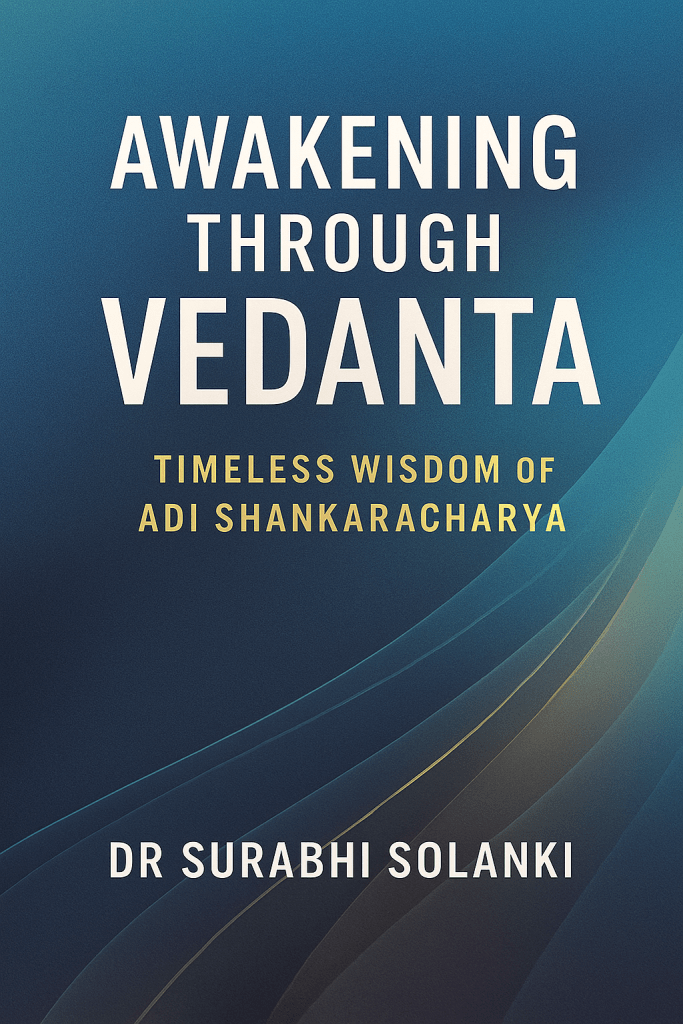
These books are ideal for:
- Beginners in Advaita Vedanta
- Serious spiritual seekers
- Readers seeking clarity without complexity
- Those who want philosophy that transforms understanding, not belief
Advaita Vedanta in One Sentence
Advaita Vedanta teaches that freedom is not achieved by becoming something else, but by recognizing what you already are.
Final Summary: What Is Advaita Vedanta Philosophy?
✔ A philosophy of non-duality
✔ Rooted in the Upanishads
✔ Clarified by Adi Shankaracharya
✔ Focused on self-knowledge, not belief
✔ Liberation through understanding, not action
Advaita Vedanta does not promise heaven.
It reveals truth.
Continue Your Exploration
If this article clarified your understanding, the books by Dr. Surabhi Solanki offer a deeper, clearer, and more practical immersion into Advaita Vedanta—written for the modern mind, grounded in timeless wisdom.
Truth does not need belief.
It needs understanding.

 Dr Surabhi Solanki