If you are searching “what are the teachings of Advaita Vedanta”, you are asking about the core insights of one of the most profound philosophical systems in human history. Advaita Vedanta does not offer beliefs to accept or rituals to perform—it offers clear understanding that dissolves suffering at its root.
This article explains the central teachings of Advaita Vedanta in simple, authentic language and shows how modern readers can study these teachings clearly through contemporary books.
What Is Advaita Vedanta?
Advaita Vedanta is a system of philosophy rooted in the Upanishads, systematically expounded by Adi Shankaracharya.
The word Advaita means “not two.”
Advaita Vedanta teaches that reality is non-dual—there is only one truth, not two separate entities like God and soul, or world and consciousness.
The Core Teachings of Advaita Vedanta
1. Brahman Alone Is Real
The first and foundational teaching is:
Brahman (pure consciousness) alone is real.
Brahman is:
- Infinite
- Changeless
- Formless
- Beyond time, space, and causation
It is not a deity with form—it is the reality in which all experiences appear.
2. The World Is an Appearance (Mithyā)
Advaita Vedanta does not deny the world.
It explains that the world is relatively real, not absolutely real.
Just as:
- A dream feels real while dreaming
- But disappears upon waking
Similarly, the world appears real due to ignorance (avidyā).
This teaching removes fear and attachment, not responsibility.
3. Atman Is Brahman (You Are That)
One of the most famous teachings of Advaita Vedanta is:
Ātman (the Self) is identical to Brahman.
This means:
- Your true nature is not the body
- Not the mind
- Not personality or memory
- But the awareness in which all experiences occur
Liberation is recognizing this fact—not becoming something new.
4. Ignorance Is the Cause of Bondage
According to Advaita Vedanta:
- Bondage is not physical
- Bondage is not caused by the world
- Bondage is misunderstanding of one’s true nature
This ignorance creates:
- Fear
- Desire
- Suffering
- Endless seeking
5. Knowledge Is the Means to Liberation
Advaita Vedanta teaches:
Liberation comes through knowledge (jñāna), not action.
- Actions purify the mind
- Knowledge frees the Self
No ritual, meditation, or practice can produce liberation—
because the Self is already free.
6. Liberation Is Here and Now
Liberation (moksha) is:
- Not after death
- Not in another world
- Not a future event
Liberation is clarity in the present moment.
A liberated person lives:
- Fully in the world
- Without inner bondage
- Without fear of loss
7. Life Continues, Suffering Ends
Advaita Vedanta does not teach withdrawal from life.
A liberated person:
- Performs duties naturally
- Engages in relationships
- Experiences pleasure and pain
- But is inwardly free
Freedom is psychological and existential, not physical escape.
The Key Texts That Teach Advaita Vedanta
Advaita Vedanta is based on three foundational sources:
- Upanishads – reveal the truth intuitively
- Bhagavad Gita – applies wisdom to life
- Brahma Sutra – systematizes and defends the philosophy
These are traditionally explained through Adi Shankaracharya’s commentaries.
Why Advaita Vedanta Is Still Relevant Today
In a world filled with:
- Anxiety
- Burnout
- Identity confusion
- Endless self-improvement
Advaita Vedanta addresses the root problem:
Mistaking what you are not for what you are.
When this misunderstanding ends, peace is natural.
Understanding Advaita Vedanta Clearly (Without Struggle)
Many readers find Advaita Vedanta difficult because classical texts are:
- Extremely condensed
- Written for monks or scholars
- Filled with technical language
To make these teachings accessible, Dr. Surabhi Solanki has authored a series of modern, faithful books that simplify without diluting the philosophy.
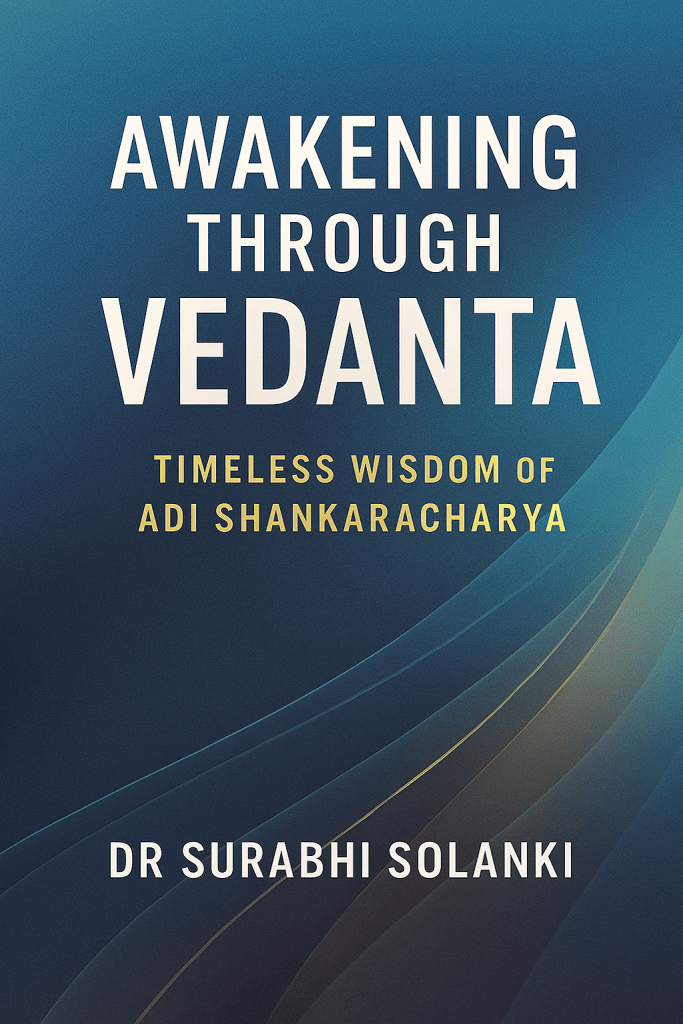
Recommended Books
- Awakening Through Vedanta: Timeless Wisdom of Adi Shankaracharya
- Essence of Yoga Vasistha: The Book of Liberation
- Divine Truth Unveiled: Hidden Secrets of Gaudapada’s Mandukya Karika
- Bhagavad Gita: Insights from Adi Shankaracharya
These books are ideal for:
- Beginners in Advaita Vedanta
- Serious seekers
- Readers seeking clarity, not belief
- Those who want philosophy that transforms understanding
Summary: The Teachings of Advaita Vedanta
✔ Reality is non-dual
✔ Consciousness alone is real
✔ The Self is already free
✔ Ignorance causes suffering
✔ Knowledge dissolves bondage
✔ Liberation is here and now
Advaita Vedanta does not promise a better future.
It reveals the truth of the present.
Continue Your Exploration
If these teachings resonate with you, the books by Dr. Surabhi Solanki offer a clear and practical path into Advaita Vedanta—written for the modern mind, grounded in timeless wisdom.
Truth is not something to achieve.
It is something to recognize.


 Dr Surabhi Solanki