If you are searching “what is moksha according to Advaita Vedanta”, you are seeking the true meaning of liberation, not as a mystical promise after death, but as a living reality attainable through understanding.
Advaita Vedanta presents moksha in a way that is radically different from popular religious or spiritual ideas. It does not describe moksha as a reward, a destination, or an altered state—it reveals moksha as freedom from misunderstanding.
This article explains moksha according to Advaita Vedanta clearly and completely, and shows how you can understand it deeply through modern, reader-friendly books.
What Does Moksha Mean in Advaita Vedanta?
In Advaita Vedanta, moksha means:
Freedom from ignorance about one’s true nature.
It is not:
- Escape from the world
- Destruction of the body
- Attainment of heaven
- A future event after death
Moksha is recognition of truth here and now.
The Core Teaching: You Are Already Free
Advaita Vedanta makes a bold declaration:
The Self was never bound. Therefore, it does not need to be liberated.
Bondage exists only as misidentification—taking oneself to be the body, mind, personality, or story.
Moksha happens when this misunderstanding ends.
Moksha Is Not an Experience
One of the most misunderstood ideas is that moksha is a special experience.
Advaita Vedanta clearly states:
- All experiences come and go
- Whatever comes and goes cannot be liberation
- Moksha is unchanging awareness, not a passing state
Liberation is clarity, not ecstasy.
The Role of Knowledge (Jnana) in Moksha
According to Advaita Vedanta:
Knowledge alone liberates.
This does not mean intellectual information.
It means direct understanding of reality.
- Actions purify the mind
- Meditation may calm the mind
- Knowledge removes ignorance
That is why moksha is immediate when understanding is complete.
Moksha While Living (Jivanmukti)
Advaita Vedanta teaches jivanmukti—liberation while living.
A liberated person:
- Lives an ordinary life
- Performs duties naturally
- Experiences pleasure and pain
- But is internally free and unattached
Life continues.
Suffering does not.
Moksha and the World
Advaita Vedanta does not deny the world.
It explains that:
- The world is experienced, not absolutely real
- Like a dream, it appears real until understood
- Moksha is seeing the world without confusion
This brings peace without withdrawal.
Moksha According to the Upanishads
The Upanishads repeatedly declare:
- You are not the body
- You are not the mind
- You are pure awareness
- Knowing this is liberation
Adi Shankaracharya emphasized that even a single Upanishad, if understood properly, is sufficient for moksha.
Moksha vs Popular Spiritual Ideas
| Popular Belief | Advaita Vedanta |
|---|---|
| Moksha after death | Moksha here and now |
| Liberation as achievement | Liberation as recognition |
| Practice produces freedom | Knowledge reveals freedom |
| Escape from life | Freedom within life |
This is why Advaita Vedanta feels revolutionary and timeless.
Why Moksha Is Relevant Today
In modern life, suffering often appears as:
- Anxiety
- Burnout
- Identity confusion
- Fear of failure or loss
Advaita Vedanta reveals that suffering is not caused by life—but by misunderstanding oneself.
Moksha is the end of that misunderstanding.
Understanding Moksha Clearly (Without Confusion)
Classical texts often make moksha seem:
- Abstract
- Philosophical
- Meant only for monks or scholars
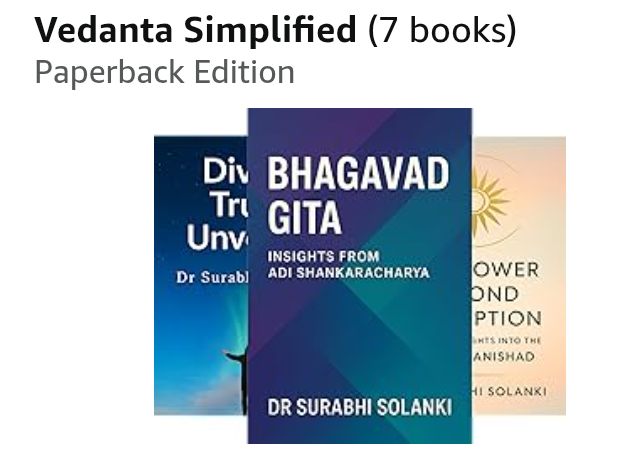
To make this wisdom accessible, Dr. Surabhi Solanki has written modern, faithful books that explain moksha without dilution.
Recommended Reading
- Awakening Through Vedanta: Timeless Wisdom of Adi Shankaracharya
A clear foundation for understanding moksha and non-duality. - Essence of Yoga Vasistha: The Book of Liberation
A profound explanation of liberation through understanding the mind. - Divine Truth Unveiled: Hidden Secrets of Gaudapada’s Mandukya Karika
A direct exposition of moksha through consciousness and non-origination.
These books are ideal for readers who want clarity, not complexity. You can search and buy these books on Amazon.
Moksha in One Sentence (Advaita Vedanta)
Moksha is knowing that you were never bound—and living from that understanding.
Final Summary: What Is Moksha According to Advaita Vedanta?
✔ Moksha is freedom from ignorance
✔ It is not a future reward
✔ It is not an experience
✔ It is knowledge of one’s true nature
✔ It is possible while living a normal life
Advaita Vedanta does not promise liberation someday.
It reveals freedom now.
Continue the Journey
If this teaching resonates with you, the books by Dr. Surabhi Solanki offer a clear and practical path into the heart of moksha—rooted in ancient wisdom, written for the modern mind.
Freedom is not distant.
It begins with understanding.

 Dr Surabhi Solanki