If you are searching “what are the main teachings of the Upanishads”, you are exploring the core philosophy of Indian spiritual wisdom. The Upanishads do not deal with rituals, mythology, or moral commandments. They deal with truth, self-knowledge, and liberation.
They ask the most fundamental human questions:
- Who am I?
- What is real?
- Why do I suffer?
- What is freedom?
This article explains the main teachings of the Upanishads clearly, simply, and accurately—without religious complexity.
What Are the Upanishads?
The Upanishads are the philosophical culmination of the Vedas, often called Vedānta (the end or highest meaning of the Vedas).
They are not instructional manuals or belief systems.
They are records of inquiry and realization.
Their purpose is not to add knowledge—but to remove ignorance.
The Central Aim of the Upanishads
The Upanishads have one primary goal:
To reveal the true nature of the Self and reality, and thereby end suffering.
Everything they teach serves this purpose.
1. The Self (Ātman) Is the True You
One of the most important teachings of the Upanishads is:
You are not the body, not the mind, not the personality.
You are the Self (Ātman)—pure awareness.
The Upanishads repeatedly point out that:
- The body changes
- The mind changes
- Thoughts come and go
But the knower of all change does not change.
That unchanging knower is the Self.
2. Brahman Is the Ultimate Reality
The Upanishads declare that behind the entire universe lies one reality, called Brahman.
Brahman is described as:
- Infinite
- Changeless
- Formless
- Beyond time and space
- Pure consciousness
Brahman is not a personal god—it is the ground of existence itself.
3. Atman Is Brahman (Non-Duality)
The most famous Upanishadic teaching is:
Ātman (the Self) is Brahman (ultimate reality).
This means:
- There are not two realities (you and the universe)
- Separation is a misunderstanding
- Truth is non-dual (Advaita)
This insight is the foundation of Advaita Vedanta.
4. Ignorance Is the Cause of Suffering
The Upanishads explain that suffering does not arise because:
- The world is bad
- Life is unfair
- God is punishing us
Suffering arises due to ignorance (avidyā)—mistaking:
- The temporary for the permanent
- The body-mind for the Self
- Appearance for reality
When ignorance ends, suffering ends.
5. Knowledge Liberates (Not Action)
A central and revolutionary teaching of the Upanishads is:
Liberation is attained through knowledge, not action.
Actions (karma):
- Produce temporary results
- Can purify the mind
- Cannot remove ignorance
Only right understanding can dissolve ignorance.
This is why the Upanishads emphasize jnāna (knowledge).
6. Liberation (Moksha) Is Here and Now
The Upanishads do not describe liberation as:
- Heaven after death
- A future reward
- A mystical state
Liberation (moksha) is:
- Freedom from false identity
- Clear knowledge of the Self
- Possible while living
This state is called jivanmukti—liberation while alive.
7. The World Is Experienced, Not Absolute
The Upanishads do not deny the world.
They explain that:
- The world is experienced
- It depends on consciousness
- It is not absolutely real
This teaching helps one:
- Live responsibly
- Without psychological bondage
- Without fear or attachment
8. Inquiry Is Essential
The Upanishads encourage:
- Questioning
- Reflection
- Direct inquiry
- Dialogue with a teacher
They do not promote blind belief.
Truth must be understood, not accepted on faith.
9. Renunciation Is Mental, Not Physical
The Upanishads clarify that true renunciation means:
- Dropping false identification
- Letting go of ignorance
- Not escaping life
One can live fully in the world and still be free.
10. Silence Is the Highest Teaching
Many Upanishads end not with explanation—but with silence.
Why?
Because ultimate truth:
- Cannot be objectified
- Cannot be fully described
- Can only be recognized
The Core Teachings of the Upanishads (Summary)
✔ You are the Self (Ātman), not the body or mind
✔ Brahman alone is real
✔ Atman is Brahman (non-duality)
✔ Ignorance causes suffering
✔ Knowledge liberates
✔ Liberation is possible here and now
✔ The world is experienced, not absolute
✔ Inquiry is essential
Understanding the Upanishads Clearly Today
Traditional Upanishad texts can feel symbolic and difficult. To make their wisdom accessible without dilution, Dr. Surabhi Solanki has written modern, faithful interpretations rooted in classical Vedanta.
Recommended Books
- Power Beyond Perception: Modern Insights into the Kena Upanishad
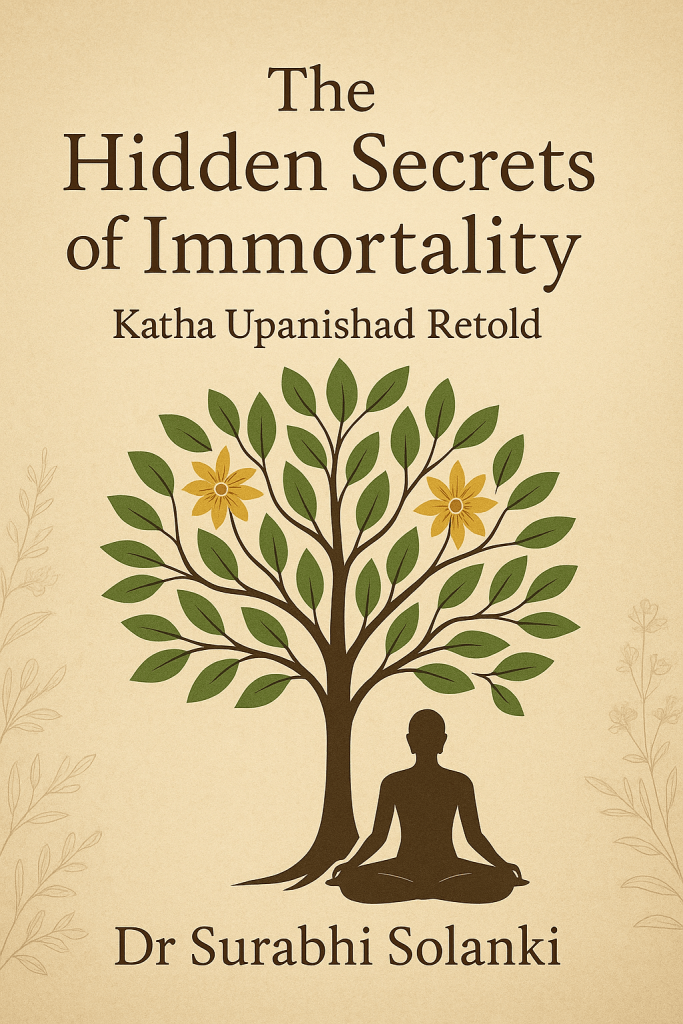
- The Hidden Secrets of Immortality – Katha Upanishad Retold
- Divine Truth Unveiled: Hidden Secrets of Gaudapada’s Mandukya Karika
- Awakening Through Vedanta: Timeless Wisdom of Adi Shankaracharya
These books are ideal for readers seeking clarity, depth, and direct understanding.
Final Answer: What Are the Main Teachings of the Upanishads?
The Upanishads teach that knowing who you truly are ends all suffering.
They do not offer beliefs to follow.
They offer truth to be realized.
Closing Insight
The Upanishads do not give answers to life.
They remove the confusion about who lives it.
If you wish to explore the Upanishads with clarity and depth, the books by Dr. Surabhi Solanki offer a modern, authentic gateway into this timeless wisdom.

 Dr Surabhi Solanki